


What matters more when building a large farm shed: saving money upfront or having enough space to move machinery without obstacles?
It’s a question worth considering before construction begins. A shed might look spacious on paper, but internal support poles can make storing tractors, trailers and other large equipment surprisingly difficult.
For New Zealand farmers, choosing between a centrepole and clearspan shed isn’t simply about building size. It’s about how efficiently you can use the space, how much the building costs to construct and whether it will still meet your needs in the future.
Understanding the practical differences between these two designs can help you avoid costly compromises.
In this guide, you’ll learn how centrepole and clearspan sheds compare and which design makes the most sense for different farming operations.
Table of Contents
- What Is the Difference Between Centrepole and Clearspan Sheds?
- How Do Internal Poles Affect Usable Space?
- Comparing Construction Costs and Long-Term Value
- Which Shed Design Works Best for Different Farm Uses?
- What Should NZ Farmers Consider Before Building?
- How to Choose the Right Shed for Your Farm
- Build for Tomorrow, Not Just Today
What Is the Difference Between Centrepole and Clearspan Sheds?
The main difference between these designs is how the roof is supported.
Centrepole Sheds
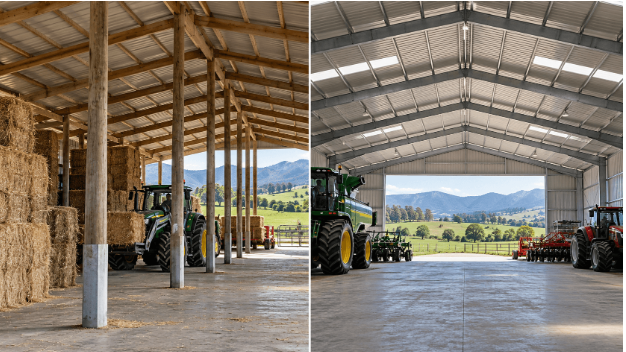
A centrepole shed uses one or more internal columns to support its roof structure. These poles carry part of the roof load, reducing the distance that the roof framing needs to span without support.
This is a common approach in traditional agricultural buildings, particularly those used for hay storage, general equipment and smaller farming operations.
Centrepole sheds can offer several advantages:
- Often have lower initial kitset costs.
- Work well when internal poles don’t interfere with storage.
- Can be designed to handle demanding weather conditions.
- Suit buildings with clearly divided storage areas.
However, the biggest limitation is the internal support poles themselves. They can restrict vehicle movement and make rearranging equipment more difficult.
Clearspan Sheds
A clearspan shed eliminates internal support poles. Instead, the roof structure spans between supports located around the building’s perimeter.
This creates a completely open internal floor area.
Clearspan designs are particularly useful for large agricultural buildings where machinery needs to move freely.
Their main advantages include:
- Uninterrupted space for large machinery.
- Easier movement and positioning of vehicles.
- Flexible storage layouts.
- Greater freedom to change the shed’s purpose later.
Clearspan buildings may require a greater initial investment because the roof must be engineered to span the building without intermediate supports.
Centrepole vs Clearspan: Quick Comparison
| Feature | Centrepole Shed | Clearspan Shed |
| Internal supports | One or more centre poles | No internal poles |
| Usable floor space | Restricted by pole positions | Fully open |
| Machinery movement | Requires careful manoeuvring | Easier access and movement |
| Initial kitset cost | Often lower | Generally higher |
| Installation | May require extra foundations and labour | Depends on structural design |
| Storage flexibility | More limited | Highly flexible |
| Ideal applications | Hay and general storage | Large machinery, workshops and multipurpose storage |
Both designs can provide reliable agricultural buildings. The better choice depends on how you intend to use your shed.
How Do Internal Poles Affect Usable Space?
Imagine building a shed that’s 18 metres wide and 24 metres long.
On paper, that’s 432 square metres of floor space. However, usable space isn’t always the same as total floor area.
In a centrepole shed, a line of internal columns may divide the building into separate storage zones.
You might have enough space to park several tractors, but moving one out could require shifting other equipment first.
This becomes particularly frustrating when machinery is used frequently.
For farmers comparing farm sheds in NZ, the position of internal supports should be just as important as the building’s overall dimensions. A clearspan layout can make the same floor area significantly easier to use, especially when storing wide implements or regularly moving equipment.
Why Clearspan Space Matters
Consider a typical machinery shed containing:
- A tractor with a front-end loader.
- A large cultivation implement.
- A fertiliser spreader.
- A stock trailer.
- Several smaller attachments.
With internal poles, each machine needs to be positioned around fixed obstacles.
A clearspan layout removes these restrictions, giving you more flexibility to organise equipment according to how often it’s used.
That doesn’t mean centrepole sheds are impractical.
If you’re storing hay bales or equipment that rarely moves, strategically positioned poles might have little effect on your operations.
The important question is how often you need to move around inside the building.
Comparing Construction Costs and Long-Term Value
Cost is often a major consideration when investing in a large farm shed.
Centrepole sheds frequently have a lower initial kitset price because internal supports reduce the structural demands placed on the roof framing.
However, the kitset price doesn’t necessarily reflect the total installed cost.
Installation Costs Can Change the Comparison
Centrepole designs may require additional post holes, concrete and on-site assembly work.
These requirements can increase labour and installation costs.
Clearspan sheds may have more expensive structural components, but some prefabricated designs can reduce assembly time and simplify certain stages of construction.
The total cost depends on several factors:
- Building dimensions and roof span.
- Site preparation and ground conditions.
- Foundation requirements.
- Transport and equipment hire.
- Installation labour.
- Engineering and consent expenses.
When comparing quotations, make sure both options include the same scope of work.
Think Beyond the Purchase Price
A cheaper building isn’t necessarily the more economical choice over its lifetime.
For example, if internal poles make moving machinery difficult, you might spend extra time rearranging equipment every week.
There’s also a greater possibility of accidental contact between machinery and structural columns.
Over time, these inconveniences can affect productivity and increase the risk of damage.
A clearspan shed may cost more initially, but the unrestricted space can offer better value for farmers who frequently use large machinery.
Which Shed Design Works Best for Different Farm Uses?
Different farming activities place different demands on a building.
Understanding your main storage requirements makes choosing between centrepole and clearspan designs much easier.
1. Hay and Feed Storage
Centrepole sheds can work well for hay storage, particularly when bales are stacked in predictable arrangements.
If the poles don’t interfere with loading equipment or bale placement, a centrepole design may offer a cost-effective solution.
However, a clearspan shed may be more practical where loaders need unrestricted access throughout the building.
2. Large Machinery Storage
Clearspan sheds are generally the more practical option for storing large tractors, harvesters and cultivation equipment.
Without internal poles, you have greater freedom to position machinery and move between storage bays.
This is especially useful during busy periods when equipment needs to be accessed quickly.
3. Farm Workshops
Both designs can work for workshops.
A centrepole shed may suit a workshop divided into dedicated areas for tools, benches and storage.
Clearspan sheds provide more flexibility when working on large vehicles or moving equipment around.
The unrestricted layout can also make it easier to reorganise the workshop as your needs change.
4. Multi-Purpose Farm Buildings
If your shed will serve several purposes, clearspan construction often offers more versatility.
For example, a space used for machinery storage today might be converted into a larger workshop or different agricultural storage area later.
Without internal poles, you’re less restricted when changing the layout.
What Should NZ Farmers Consider Before Building?
Beyond storage requirements, New Zealand’s environmental conditions and building regulations play an important role in shed design.
Wind, Snow and Structural Requirements
Farm sheds must be designed for the conditions at their specific location.
According to the New Zealand Building Code’s structural requirements, buildings must withstand relevant loads, including wind and earthquakes.
Snow loading is another important consideration in certain regions.
A centrepole shed may be a practical choice in areas with demanding roof loads because its internal columns help support the structure.
However, clearspan sheds can also be engineered for high wind and snow loads.
Neither design is automatically stronger in every situation. Structural performance depends on the complete engineered design rather than the presence or absence of centre poles alone.
Building Consent Requirements
Large agricultural buildings commonly require building consent.
New Zealand has specific exemptions for certain rural pole sheds and hay barns, but these have strict limitations.
For example, the Ministry of Business, Innovation and Employment’s rural shed exemption guidance includes a maximum floor area of 110 square metres and a maximum unsupported roof span of six metres, alongside several other conditions.
Many large machinery sheds fall outside these exemptions.
Check your project’s consent requirements with the relevant council or a qualified building professional before starting construction.
Safe Machinery Movement
Internal layout also influences how safely you can operate farm vehicles.
Large machinery requires adequate space for turning, reversing and moving around stored equipment.
WorkSafe New Zealand’s guidance on safe farm vehicle operation highlights the importance of managing risks associated with agricultural vehicles and attached machinery.
When planning a shed, consider whether internal poles could create blind spots, narrow passageways or awkward reversing manoeuvres.
A clearspan building can reduce some physical obstacles, although safe access and appropriate operating practices remain essential regardless of the shed design.
How to Choose the Right Shed for Your Farm
The best approach is to plan your shed around your actual working requirements rather than choosing a structure based on price alone.
Before making your decision, consider the following questions.
- What will you store?
List your largest machinery and its dimensions, including attachments. Make sure there’s enough clearance around everything.
- How frequently will equipment move?
If you’re accessing machinery daily, unrestricted space becomes more valuable.
- Will internal poles interfere with your layout?
Draw a simple floor plan showing where equipment will sit and how it will enter and leave the building.
- What is your total construction budget?
Compare complete installed costs, not just kitset prices.
- Could your storage requirements change?
Consider whether your machinery, livestock operation or workshop needs might expand over the next decade.
- What are the conditions on your property?
Your location, wind exposure, snow loads and ground conditions may influence the engineering requirements.
A useful exercise is to mark out the proposed shed layout and internal pole positions on paper. Add scaled outlines of your largest equipment and the space needed to manoeuvre it.
You’ll quickly see whether a centrepole layout is practical or whether a clearspan design offers meaningful benefits.
Build for Tomorrow, Not Just Today
Choosing between a centrepole and clearspan farm shed comes down to how you intend to use the building.
Centrepole sheds can be a practical, cost-effective option for straightforward agricultural storage, particularly when internal supports don’t interfere with daily operations.
Clearspan sheds offer greater flexibility, making them particularly attractive for large machinery storage, workshops and multipurpose agricultural buildings.
Neither design is automatically right for every farm.
Before investing, consider how your machinery moves, how frequently you’ll access stored equipment and whether your storage needs could change.
A farm shed should make everyday work easier, not create obstacles you have to work around.
Choose the layout that supports the way your farm operates today while leaving room for what tomorrow might bring.