

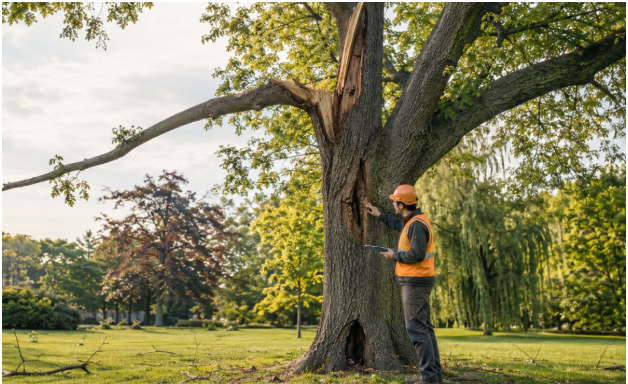

A damaged tree does not always need to be removed. Trees can sometimes recover from broken branches, trunk wounds, root disturbance, and storm damage when their essential structure remains sound. However, a tree that appears healthy from a distance may contain hidden decay or instability. Arborists use a systematic damaged tree assessment to determine whether preservation is practical and safe.
Identifying the Cause of Damage
The assessment begins with understanding what happened. Storms may split major limbs, lightning can damage internal tissue, construction may sever roots, and vehicles or equipment can injure the trunk. Insects, disease, drought, and soil problems may also weaken a tree gradually.
The timing and cause of the damage help an arborist estimate the tree’s ability to respond. A recent broken branch on an otherwise vigorous tree may be manageable. Extensive decay that developed over many years may present a more serious concern.
Examining the Tree’s Overall Condition
Before focusing on the obvious injury, the arborist considers the whole tree. Species, age, size, growth pattern, and general vitality all affect the recommendation. Some species tolerate pruning and structural damage better than others.
Healthy foliage, normal annual growth, and good branch development may indicate that the tree still has enough energy to recover. A thin canopy, undersized leaves, dead branches, or widespread discoloration can suggest decline. Multiple stress factors often reduce the likelihood of successful preservation.
Inspecting Roots and the Root Collar
Roots provide both structural support and access to water and nutrients. During a damaged tree assessment, the arborist looks for severed roots, lifting soil, fungal growth, decay, soil compaction, and changes near the trunk base.
A tree may become unstable when major roots are cut during excavation or damaged by severe weather. Root problems are especially important because much of the root system is underground and cannot be evaluated through a simple visual inspection. When necessary, specialized methods may be used to investigate hidden conditions while limiting further injury.
Evaluating the Trunk and Main Branches
The arborist examines cracks, cavities, missing bark, decay, and weak branch unions. The location of a defect matters as much as its size. Damage involving the main trunk, several large roots, or a major junction can have greater structural consequences than a broken outer branch.
Some trees develop included bark where two stems grow closely together without forming a strong connection. If storm damage exposes or enlarges this weakness, the likelihood of future failure may increase.
Arborists may sound the trunk, probe damaged areas, or use diagnostic equipment when internal decay is suspected. The objective is to estimate how much sound wood remains and whether it can support the tree.
Considering Nearby Targets
Risk depends partly on what could be struck if the tree or a branch failed. A damaged tree in an isolated field presents a different situation from one beside a home, playground, road, parking area, or busy walkway.
The arborist considers the likelihood of failure, the likelihood of impact, and the potential consequences. A defect that may be tolerable in a low-use area could require stronger action where people or valuable property are regularly present.
Comparing Treatment Options
If the tree can reasonably be retained, the recommendation may include selective pruning, removal of broken limbs, supplemental support systems, protection of the root zone, irrigation, soil improvement, or scheduled monitoring. Topping is generally not an appropriate repair because it creates large wounds and encourages weak new growth.
Removal may be recommended when the tree has lost essential structural support, contains extensive decay, is rapidly declining, or presents a risk that cannot be reduced to an acceptable level. The decision should account for both immediate hazards and future maintenance.
A Balanced Professional Judgment
Saving a mature tree can preserve shade, habitat, beauty, and environmental value. Safety, however, must remain the priority. A thorough damaged tree assessment combines visible evidence, site conditions, tree biology, and likely consequences. This careful process allows an arborist to recommend preservation when practical—and removal when the damage is too severe.
This post was written by a professional arborist at Tree Removal Clearwater FL. Robert Miller is the owner of Arbor Wise Professional Tree Care, a locally owned and operated tree service company that offers superb lawn care by the most experienced Arborists. Arborwise Tree Services is a tree removal company that offers stump removal, tree pruning, stump grinding, fertilization, and tree restoration. We have an extraordinary lawn care industry notoriety covering the Pinellas county area.