

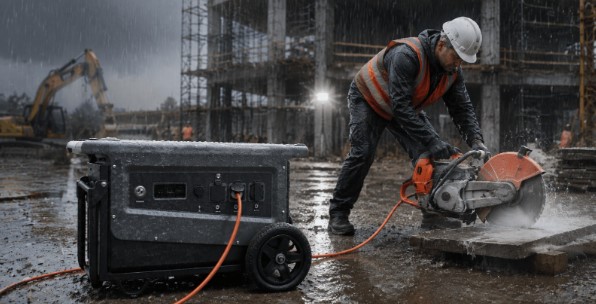

If you were to visit any construction site that is under way and you have the patience to be there long enough to observe the happenings, it wouldn’t take you long to conclude that power is the ultimate necessity on any work site. Wires are being laid throughout the mud, generators are providing power on the outer periphery of the work site, and half the people just wait for power to become available, it is necessary for work to be done or not done at all. That’s why a growing number of contractors, electricians and site managers are turning to the Industrial Power Station designed specifically for tough, unpredictable conditions. These are not your standard backup batteries that you’ll have in your garage or office, these models are built from the ground up to withstand dust, vibration, temperature changes, and crucially water.
Why Construction Sites Need More Than a Regular Generator
For decades gas powered cars have been used, and they will probably be used for a long time to come. Nevertheless, there are some considerable disadvantages of gas powered generators that should not be ignored before purchasing a genset. First, the usage of gas powered generators requires a significant amount of space for storing the fuel. Secondly, because of the emissions of the generator, it cannot be used inside of the building. Gas powered generators also tend to be very noisy and drain a lot of time that could be spent doing something more productive. Lastly, regular generators are not suitable for wet weather or even a high degree of atmospheric humidity.
That gap is where a Waterproof Power Station really works. Rather than worrying about tarps, shelters, or powering down equipment as soon as the clouds roll in, the teams can work through a light drizzle, the occasional patch of damp grass, the humidity of coastal mornings or the muck and grime that are inevitable on any work site. It’s simply much more resistant to water than conventional electronics are.
What Makes It “Waterproof” in a Meaningful Way
Here, it’s good to take a moment and think about what exactly waterproofing entails, as it’s one of these things that gets thrown around too easily in marketing. A proper all-weather power station is going to have things like
- Sealed enclosures with a good enough IP (ingress protection) rating to keep dust and liquids from getting to the internals,
- Corrosion resistant housing as being exposed to moisture will eventually see metal rust if left alone,
- Protected ports and connectors, sometimes even rubberized to prevent issues when you shove your gear in there.
- Insulation and drainage to prevent condensation from forming on the inside when the temperature swings between a hot day and a cold night.
This is all about long-term reliability in the face of less-than-ideal conditions, not just surviving a sudden downpour.
Real Power for Real Job-Site Demands
A construction site is not a place where light tools are used. There are impact drivers, reciprocating saws, work lights, laser levels, small compressors and, increasingly, battery-powered tools that all need recharging in the middle of the day. An industrial-grade, high performance model should provide
- Plenty of power – with enough watts to run your power tools without tripping them or overloading itself, plus enough surge power to handle big draws from tools with large-starting currents.
- Various output modes – AC for your tools, DC for your small electronics, and USB-C or USB-A for your phone and the tablet or smartphone your crew uses to stay connected and communicate on the go.
- Fast charging – from leaving it on the wall LED overnight, to using your car’s inverter on the drive to the jobsite, and even solar power if you have to leave it somewhere for an extended period.
- Lastly, it should be built to last – with reinforced corners, suspension-friendly design, and durability to withstand drops, kicks, or being tossed in the bed of a pickup without something breaking.
By having all this in one place, your crews can consolidate their charging and power needs into one reliable source.
Portability Without Sacrificing Capacity
One of the more interesting changes in this field in recent years has been the size-to-power ratio. The old backup power units were either dwarf-sized or giant-sized and impossibly bulky. That is, the compromise that defined the modern industrial inverter is almost entirely gone. Many of the modern options feature:Lightweight, durable materials in a design that doesn’t sacrifice structure for portability, which means being able to take it anywhere a construction crew goes without much loss in performance. Wheels and telescoping handles so that it can be rolled over rough ground but tucked into a truck bed or shipping container when not in use. It’s easy to lose sight of the fact that construction workers are always on the move, either from place to place or between projects. Anything that needs securing to the ground is a definite liability if it needs to come elsewhere.
Safety Benefits That Go Beyond Convenience
There are enough dangers on a construction site as it is, without having to worry about electrocution as well. Traditional generators operating near water or in enclosed spaces present hazards such as carbon monoxide buildup, exposed wires causing sparks, or fuel leaking onto machinery. A self-contained, battery-powered device cuts down on all of these dangers:
- No combustion means no exhaust, which is especially important when working with limited ventilation indoors or in a trench and if there is no fuel, it’s one less potential hazard to worry about at the jobsite.
- Interpretation housing the battery-powered generator’s seal keeps it safe from the elements, minimizing the risk of oil leaking from severe vibrations.
- Any rain or splashing water can’t get into the device and cause damage, either.
- Reduced noise allows personnel to communicate easily and hear safety announcements or machine alerts.
With all the hazards that OSHA regulations demand that managers account for and enforce, this kind of device helps to take away a few of them.
Cost Considerations Over Time
The cost of a quality unit is high, when compared to a basic gas generator, but the math usually works out in favor of the battery-powered unit. Not only is there the savings on fuel, which for 8+ hours of run-time, 5 or 6 times per week, adds up quickly, the maintenance is near nonexistent. No more oil changes, no plugs to replace, and no carburetor issues from sitting in storage in the warmer months.
Add into that reduced downtime due to weather and it becomes apparent that the overall cost savings tend to lean heavily in the direction of the battery-powered unit within the first few years of ownership, especially for those who do contract work in wetter climates, or even have a national presence and therefore face a variety of weather conditions.
Choosing the Right Unit for Your Site
Not all projects require the same size. A small crew with a few hand tools is drastically different in their requirements from a large-scale commercial project with continuous concrete pouring. Keep these points in mind when choosing:
- Power required– determine your load requirements, including surge
- Power source– will you be using a wall outlet or something more exotic like solar panels?
- Degree of protection– higher IP ratings mean more protection from water and dust ingress
- Size and weight– how often will you need to move the device from one site to another?
- Battery life and warranty– a longer lifespan is more important than a lower price
Getting these details right up front will save you tons of frustration later, particularly when the unit is already part of daily work site operations.
Final Thoughts
Construction work doesn’t stop for inclement weather, or dead batteries, and increasingly it shouldn’t. An Industrial Power Station made with true water resistance can provide a crew with the ability to keep their tools, lights, and plans going without having to worry about the weather. Add in a truly waterproof power station and you have reduced job site risks, lost time and down time overall.
Construction work doesn’t stop for inclement weather, or dead batteries, and increasingly it shouldn’t. An Industrial Power Station made with true water resistance can provide a crew with the ability to keep their tools, lights, and plans going without having to worry about the weather. Add in a truly waterproof power station and you have reduced job site risks, lost time and down time overall.